Elon Musk has said the company's value hinges on cracking autonomous driving at scale. Now, with a year-end deadline to operate Robotaxis in up to 10 cities, the company is hiring across the country to make it happen.
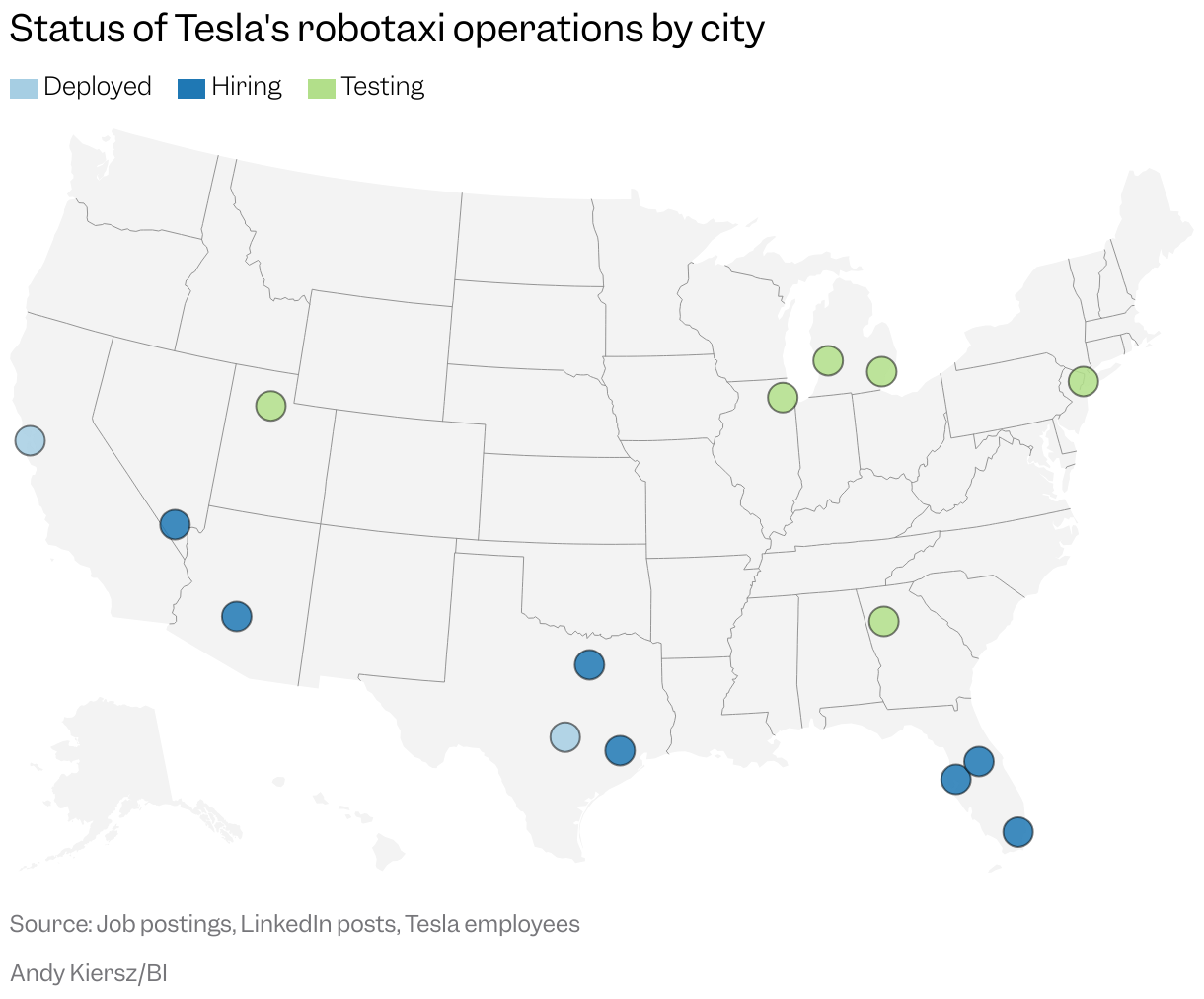
Musk said in October that Tesla plans to operate the program in eight to 10 metropolitan areas by the end of 2025, with a total of more than 1,000 vehicles. So far, it has launched in San Francisco and Austin. During its annual shareholder meeting on November 6, the company said it's targeting Las Vegas, Phoenix, Dallas, Houston, and Miami next.
But job listings paint an even broader picture.
As of early November, Tesla had more than 40 Robotaxi-related postings in cities like Orlando, Tampa, and Las Vegas. The roles, which range from support to management, appear geared toward supporting a driverless fleet by cleaning the vehicles and overseeing logistics.
In Austin, Tesla is hiring for vehicle operators and specialists who can respond to "vehicle incidents in the field." Tesla already employs three fleet support specialists in the city, according to LinkedIn. In San Francisco, the company continues to hire engineers for its Autopilot team.
The company also employs test drivers — who are responsible for training the autonomous software — in cities across the country, workers told Business Insider.
The company is looking to bring on a Robotaxi insurance claims specialist who will play "a critical role in managing incident reporting and claim processes for Tesla Robotaxi and ride-hailing operations."
The broad swath of locations — more than a dozen cities across 10 states — shows how intent Tesla and Musk are about scaling the service. Musk said in July that it would expand at "a hyper-exponential rate."
"I think we will probably have autonomous ride-hailing in probably half the population of the US by the end of the year," he added.
Musk has repeatedly said Tesla's valuation is based on its ability to launch true self-driving technology at scale. Still, Tesla has long been seen as lagging behind competitors like Waymo and Zoox. Those companies' autonomous driving technology has been deployed in half a dozen cities across the country, some operating for several years already.
Tesla's ride-hailing service has completed over 40,000 rides in California since July, according to the company. Waymo, by comparison, recorded over 700,000 rides in March alone, according to data from the California Public Utilities Commission.
Musk has said Tesla will be able to expand its service much quicker and at a lower cost using its vision-only system, which is trained on data from millions of Tesla owners and operates without expensive LiDAR and radar technology. For now, Musk said, the company will launch in many of the cities Waymo already services.
A representative for Tesla did not respond to a request for comment.
While Tesla's hiring shows the company is scaling up, some local authorities say the company has yet to take the steps for full deployment.
Representatives from the Nevada Department of Motor Vehicles and the Arizona Department of Transportation told Business Insider that Tesla has received approval to test its service in the states, but still needs to complete additional steps to begin operating the vehicles commercially.
A representative for the city of Tampa said Tesla has not been in contact with the city regarding its plans to launch a Robotaxi service.
Representatives for the other states and cities listed in job postings did not respond to a request for comment.
Tesla has been sending test drivers to cities across the US as a part of an initiative internally referred to as "Project Rodeo" as far back as 2021, according to three former test drivers. The drivers train the autonomous software how to navigate roads in major cities, including New York City, Boston, Chicago, and Detroit, while also pushing the system to the limit.
Ahead of the Austin Robotaxi launch in June, the company had around 300 test drivers in the city, Business Insider previously reported.
Regulatory roadblocks
By far the biggest obstacle to Musk's robotaxi ambitions is the patchwork regulation for autonomous vehicles in the US. A lack of a federal framework has left regulating robotaxis in the hands of the states, many of which have taken different approaches to the technology or are in the process of introducing new legislation.
Tesla has taken steps to address regulatory hurdles, particularly in California, which has some of the strictest robotaxi regulations in the country.

Companies are required to obtain multiple permits and must pass a series of milestones to test and deploy autonomous vehicles. Waymo tested driverless cars for years before getting the green light to carry paying members of the public.
Tesla currently has a permit to test autonomous vehicles with a safety driver, according to the California DMV's website. A spokesperson for the CPUC told Business Insider that Tesla has yet to apply for a permit to commercially operate autonomous vehicles.
It's able to operate a ride-hailing service in California — utilizing a fleet of vehicles equipped with Tesla's Full Self-Driving software, which is operated by a driver — under a permit that allows it to transport members of the public in a "non-AV" vehicle with a driver.
Texas has fewer AV restrictions. Until recently, companies were required to provide proof of insurance; the state is in the process of hashing out new regulations. Nevada and Florida also require proof of insurance.
A spokesperson for the Texas Department of Motor Vehicles told Business Insider that autonomous vehicle operators like Tesla will be required to receive authorization for commercial use beginning May 28, 2026.
"The department is working to make the authorization application process available to autonomous vehicle operators by late April 2026, so companies that have established active operations in the state will have an opportunity to obtain the required authorization before enforcement activities begin," the spokesperson said.
Currently, the Austin service operates with a safety operator in the passenger seat.
Regulatory holdups have shown little sign of denting Musk's optimism. During Tesla's third-quarter earnings call, the billionaire predicted that the company's robotaxi rollout would only accelerate.
"I think people just don't quite appreciate the degree to which this will take off," Musk said. "Honestly, it's going to be like a shock wave."
