Global supply chains are on edge after the US and Israel launched military strikes on Iran on Saturday, triggering widespread disruption across one of the world's most critical trade corridors.
The fallout is hitting more than oil tankers moving through the Strait of Hormuz.
Container ships loaded with consumer goods, auto parts, electronics, and food are being rerouted or delayed, while air cargo networks are fracturing under sudden airspace closures.
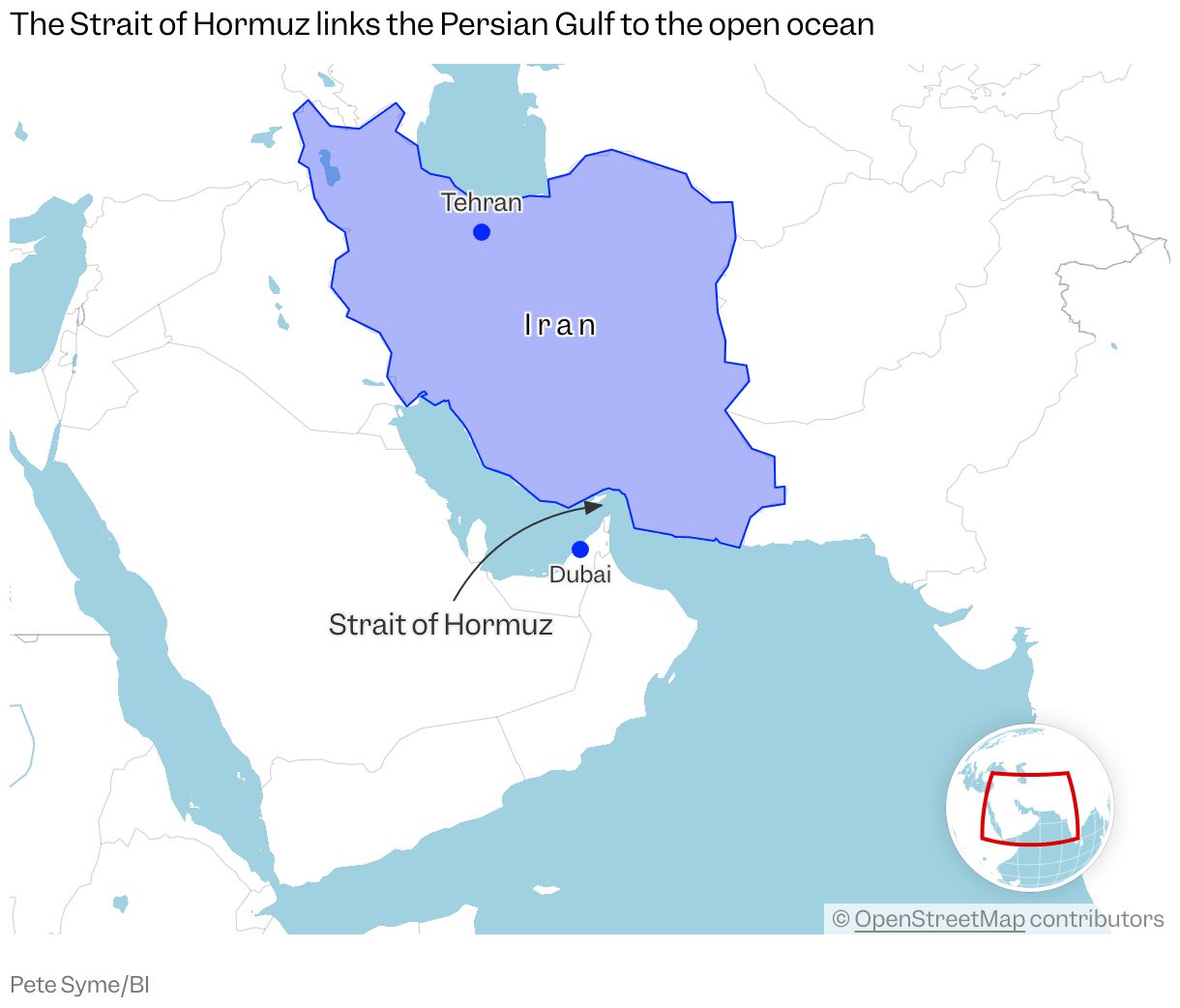
"While Iran has no legal authority to close the Strait of Hormuz, the narrow chokepoint that connects the Persian Gulf to the Indian Ocean and handles roughly one-quarter of the world's trade in oil, the start of military hostility across the region has effectively made it a no-go zone for all shipping," Simon Heaney, senior manager of container research at independent maritime research consultancy Drewry, said in a market opinion piece on Tuesday.
The strikes on Iran mean that shipping companies are likely to send more cargo around the Southern tip of Africa — a journey that adds between 10 to 15 days on average to shipments moving between Europe and Asia, Stifel analyst J. Bruce Chan wrote in a note to clients on Sunday.
That longer timeline could "effectively soak up capacity in the global fleet," Chan said.
On Sunday, MSC — the world's largest container shipping line by capacity — said it had suspended all bookings for cargo to the Middle East until further notice.
Danish shipping giant Maersk paused Red Sea and Suez Canal sailings amid fears the Iran escalation could spill over into key shipping lanes. The company is rerouting vessels around the Cape of Good Hope in South Africa.
On Monday, it said it had suspended acceptance of dangerous cargo in several Gulf countries and halted new bookings between the Indian subcontinent and key Upper Gulf markets.

French shipping giant CMA CGM announced Monday it will impose an "Emergency Conflict Surcharge" effective Monday, citing rising security risks. The surcharge will add between $2,000 and $4,000 per container on shipments to and from Gulf and Red Sea countries.
On Saturday, CMA CGM ordered vessels inside or bound for the Gulf to "proceed to shelter." It also suspended sailings through the Suez Canal and rerouted ships to the Cape of Good Hope.
German shipping giant Hapag-Lloyd introduced a $1,500 per standard container war risk surcharge and suspended vessel transits through the Strait of Hormuz.
Chinese shipping giant Cosco Shipping Lines said Sunday that vessels already in the Gulf have been instructed "to proceed to safe waters to hover or anchor."
"We are currently evaluating contingency plans for all cargo onboard the affected vessels, including potential alternative discharge ports," it said.
Japanese container shipping company Ocean Network Express (ONE) said on Monday it will temporarily suspend new bookings for cargo moving to and from the Persian Gulf until further notice.
Sailing around Africa, rather than through the Suez Canal, absorbs roughly 2.5 million 20-foot container units' worth of global container capacity, according to Peter Sand, the chief analyst at freight-rate analytics platform Xeneta.
Read more about the US-Iran conflict
It's not just shipping companies affected.
Several marine insurers — including the London P&I Club and the American Club — said they will cancel war risk cover for ships operating in Iranian waters, the Gulf, and surrounding areas from Thursday.
The exact number of ships that have remained in the area so far remains unclear.
According to Drewry's AIS intelligence data, 158 container ships were in the Persian Gulf, Arabian Sea, and Gulf of Oman as of Sunday — representing 2.1% of the active global container fleet.
Only 97 container ships were still inside the Strait of Hormuz as of Monday afternoon, most sheltering at ports or designated anchorages, according to Lloyd's List Intelligence, a provider of real-time maritime data.
A five-day playback from MarineTraffic, a vessel-tracking platform, shows vessel movements in the Strait of Hormuz dropping sharply between February 27 and March 3:
Air cargo rates may rise
Air freight is also under strain.
Several Middle Eastern airspaces have been closed or restricted, disrupting passenger and cargo flights.
Parcel delivery giant FedEx suspended flights to and from markets including Bahrain, Israel, Qatar, Saudi Arabia, Kuwait, and the UAE, and halted pickup and delivery services in several Gulf countries.
Qatar Airways Cargo temporarily suspended operations due to the closure of Qatari airspace.
DSV, a Danish logistics company, said in an advisory that airspace restrictions are forcing carriers to suspend services or divert flights and lengthen routings.
With less cargo space available on key Asia-Europe and Middle East routes, air freight rates are likely to rise, space will tighten, and airlines may make short-notice schedule and pricing changes, according to DSV.
Ryan Petersen, the CEO of Flexport, wrote on X that conflict in the Middle East has removed 18% of global air freight capacity from the market.
If carriers begin omitting Gulf port calls, containers may be discharged at alternative hubs and trucked onward, wrote Xeneta's Sand.
The broader concern, however, is what the escalation means for global trade flows through the Red Sea this year. The conflict comes after more than two years of disruption caused by Iran-backed Houthi attacks on commercial shipping.
"The repercussions of the joint military operation by the US and Israel against Iran and subsequent retaliatory action will see the further weaponization of trade and shatter hopes of a large-scale return of container shipping to the Red Sea in 2026," wrote Sand.
