Emergency rooms, maternity wards, and intensive care units are vanishing across rural America.
The phenomenon is leaving millions of people without access to medical services. Some now have to travel long distances for their annual checkup, while others worry paramedics won't arrive in time if they need help. Hospitals are major employers, and closures can leave hundreds of people without a job.
There are a few reasons why this is happening, and has been for decades. Smaller patient populations in rural areas make it difficult for hospitals to cover their operating costs, aging equipment and facilities can become too expensive to fix, and a change in ownership can tip an already-struggling hospital into the red.
This longstanding problem is also likely to get much worse — and quickly. Medicaid changes in President Donald Trump's One Big Beautiful Bill Act will limit key sources of federal funding to these hospitals, risking future closures. And the administration's $50 billion investment in rural health initiatives might not be enough to offset the harm.
Here's what to know about closures in your area.
Over 100 rural hospitals have shut their doors
Since 2005, 110 of the US' rural hospitals have closed permanently, 24 of which have shut their doors in the last five years. Researchers at The University of North Carolina found that the majority of these hospitals are in especially small and isolated locations, leaving residents with few options to see a doctor for preventive or urgent care. And many of these closure locations are near one another, creating healthcare deserts.
Nearly 800 more rural hospitals are currently at risk closure due to financial distress, the Center for Healthcare Equity and Reform estimates.
Some former hospitals become urgent cares or nursing homes
Some struggling hospitals don't shut down completely. Eighty five rural hospitals have downsized since 2005, stopping all inpatient care while still offering some outpatient services. A formerly complete hospital, for example, might be repurposed into an urgent care, nursing home, or rehab facility.
This strategy saves money, but can come at the expense of patients. Over 500 hospitals closed their labor and delivery departments in the last decade, more than half of which were in rural areas.


Rural ERs might have the only doctors around
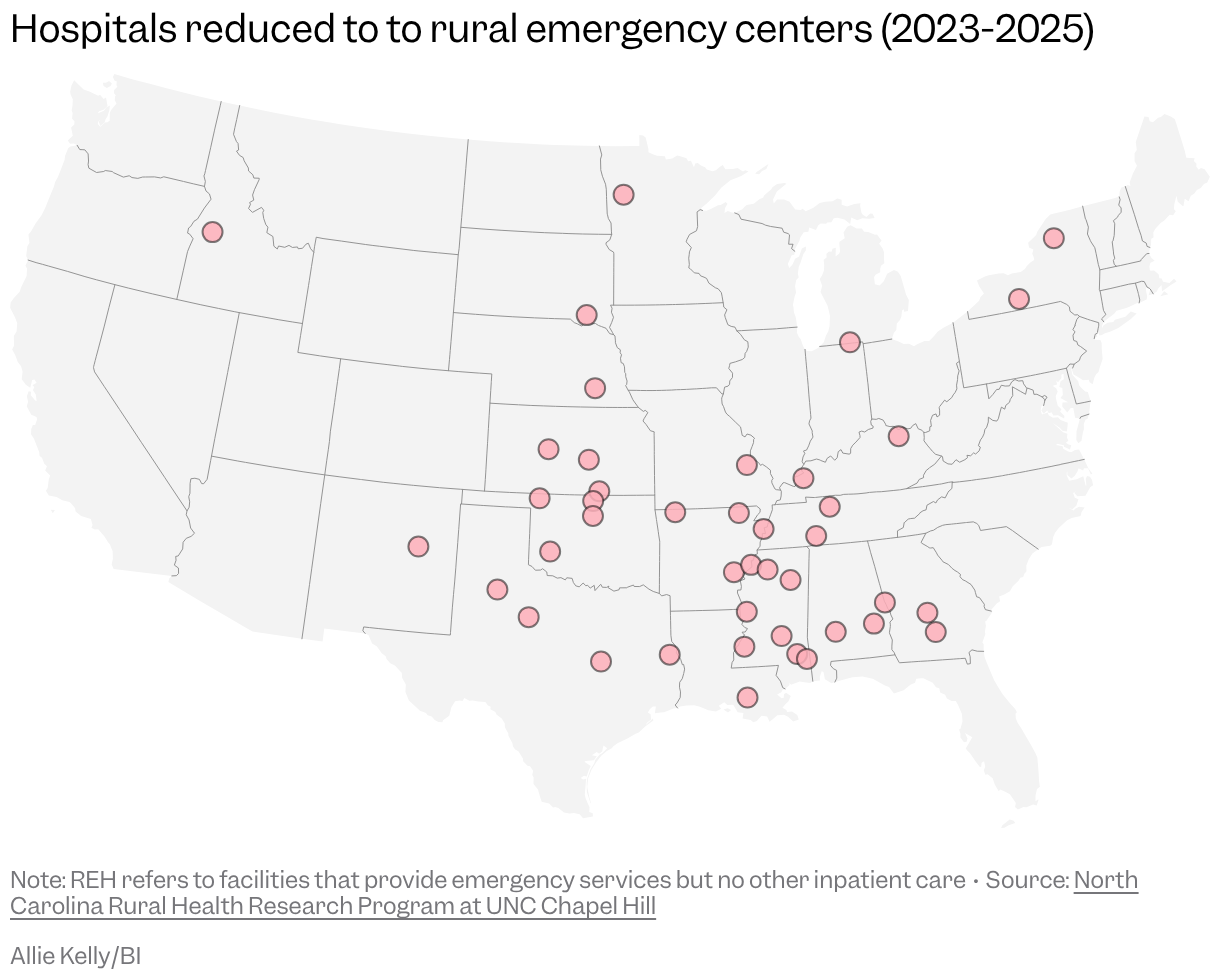
Scaled-down hospitals are occasionally repurposed into rural emergency centers, which are designed to handle immediate trauma cases. These hospitals are stand-alone ERs and don't exceed an average patient stay of 24 hours.
Since CMS began tracking it in January 2023, 42 rural hospitals have been converted into these emergency centers.
And, while rural America is hardest hit by funding challenges, urban areas aren't immune. A recent report from the Government Accountability Office found that more urban hospitals closed than opened between 2019 to 2023, with many reporting financial distress and outdated equipment in the years before closure.
Business Insider is diving into the business of hospitals and Americans' access to healthcare. If you have a story to share — or if a hospital has closed in your area — fill out the survey below.
