It's a tech bloodbath in the job market.
Friday's shockingly weak jobs report showed a loss of 92,000 jobs in February across the broader economy, far below the expected gain of 55,000 jobs. After the release, economist Joseph Politano posted on X that the tech sector has had an especially rough couple of years.
"For a while, you could at least say we're not gaining jobs the way we used to, but we're not losing them. Everything's kind of stagnant," Politano told Business Insider. "That has, over the last year, completely changed, where it's losing jobs again at one of the most rapid rates of the last 20 years."
Tech job losses now outpace past downturns in 2008 and 2020, per Politano. Historically, Politano said, the US would usually be adding around 100,000 to 300,000 jobs in tech annually; even when there have been some pullbacks, there's generally a quick rebound. But not this time.
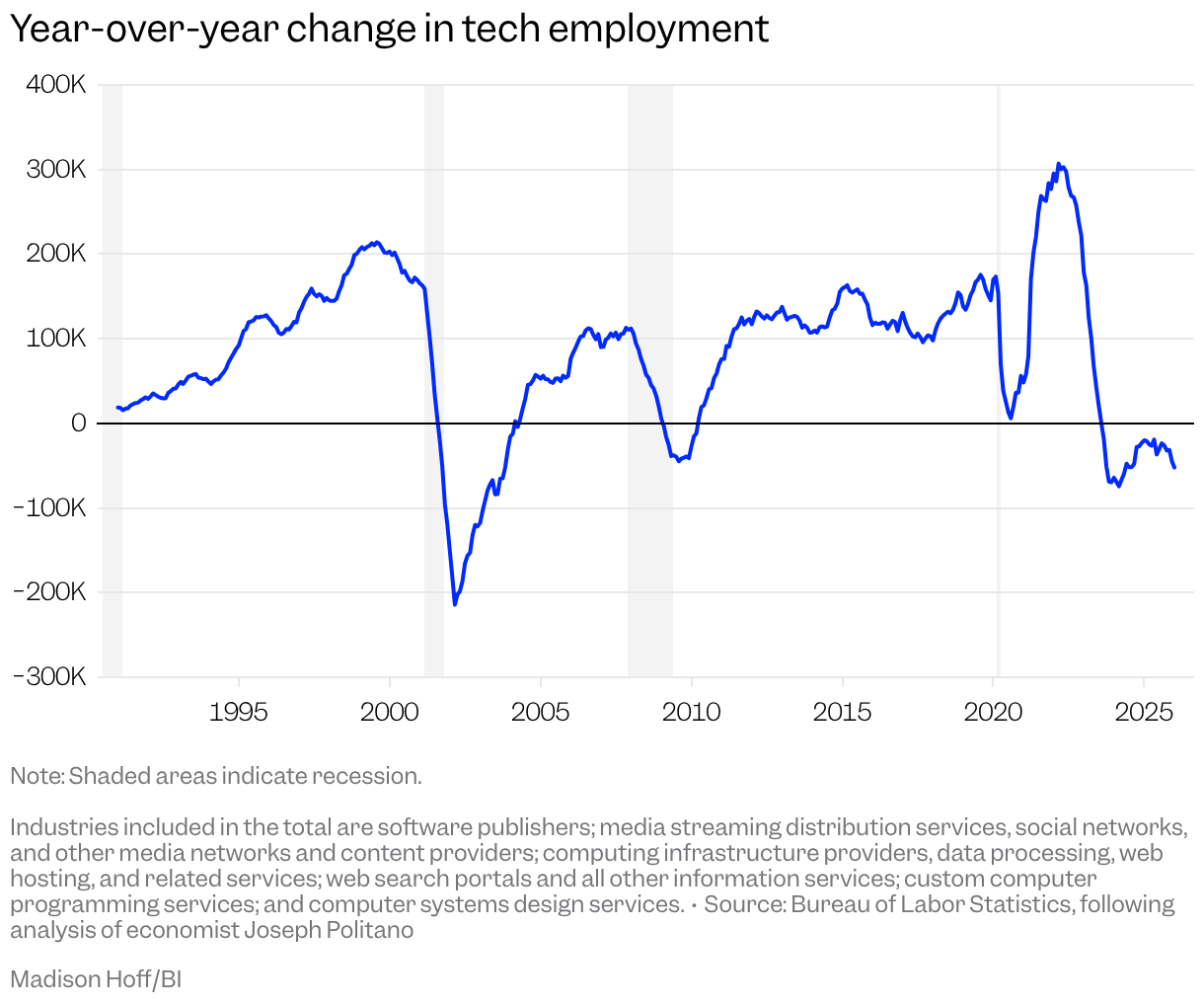
Already, Politano said, this moment is clearly and significantly worse for the sector than the 2020 recession, and slightly worse than 2008. He thinks the most apt comparison is to the dot-com bust, although today's situation still isn't quite as dire.
"The fact that the only thing that you can compare it to is the worst tech job recession of all time is pretty bad," Politano said. "The length is really important here. It's been three years of job losses. It took only about four years for recovery to start from the dot-com bust, for tech to start rehiring at a semi-normal rate again. The fact that we're now three years into this and it's actually getting worse is a really big deal."
Of course, as Cory Stahle, an economist at the Indeed Hiring Lab, notes, it's not just tech that's down in the dumps. Manufacturing, which has been cooling for the last couple of years, saw employment fall, as did the government sector. Healthcare, which had been propping up the job market, lost jobs in February, exacerbated by a roughly monthlong Kaiser Permanente strike. "Everything was looking pretty weak by different industries," Stahle said.
ZipRecruiter economist Nicole Bachaud said February's losses in tech-related sectors were similar to recent trends. "When we look at information continue to see a decline, and then the professional and business services, a little bit soft, but I wouldn't say that was necessarily an out-of-place movement for that industry," Bachaud said. "There's been a lot of headlines looking at layoffs in tech or big changes at certain employers in tech, but overall, the layoff rate has been very low and stable."
New college grads who leaned into STEM and other people seeking their first jobs could be especially hard hit by the tech hiring downturn.

"We've seen a lot about recent graduates struggling to find jobs," Stahle said. "You really feel for those people who started studying computer science four or five years ago and were told that, 'Hey, this is a surefire way to get in the labor market, make a good salary,' and now we're seeing just a continuation of this trend of fewer and fewer hires being made in the tech sector," Stahle said.
The latest job numbers also don't yet reflect the sweeping layoffs from Block, which excised nearly half its workforce last week. In his announcement outlining the cuts, CEO Jack Dorsey cited AI as a reason, saying that "the intelligence tools we're creating and using, paired with smaller and flatter teams, are enabling a new way of working." Some laid-off Block employees were skeptical about AI claims; many told Business Insider that they had already been using AI at work, and didn't believe it could replace them outright.
Politano said that, in his view, AI is likely behind at least some of the tech labor market's losses.
"How much of it you want to ascribe is really hard to tell, but I don't think it's a coincidence that computer system design is one of the industries that's losing the most jobs," Politano said. And, while AI firms are hiring, they're bringing on far fewer employees than Big Tech behemoths. The types of jobs lost, and the timing of those losses, point, for Politano, to at least some impact from AI.
"We clearly haven't seen the end of this right now," Politano said of the future of the tech sector. "I expect that it will be this dribble of bad news for the near term going forward, but I just think that there's no positive evidence that we're breaking out of this post-2022 cycle that tech has been stuck in. Until you see that kind of evidence, I think there's very little chance of a reversal."
