For a growing number of young people faced with a cancer diagnosis, one agonizing choice needs to be made quickly: Save your fertility, or hold on to those thousands of dollars — if you even have them — for treatment or whatever else life may bring.
Fertility loss is often a guaranteed side effect of chemotherapy, radiation, some surgeries, and even some targeted therapies. But egg-freezing, sperm-freezing, and IVF are generally considered "elective" procedures that you can choose to do, but don't need. So insurance coverage is rare.
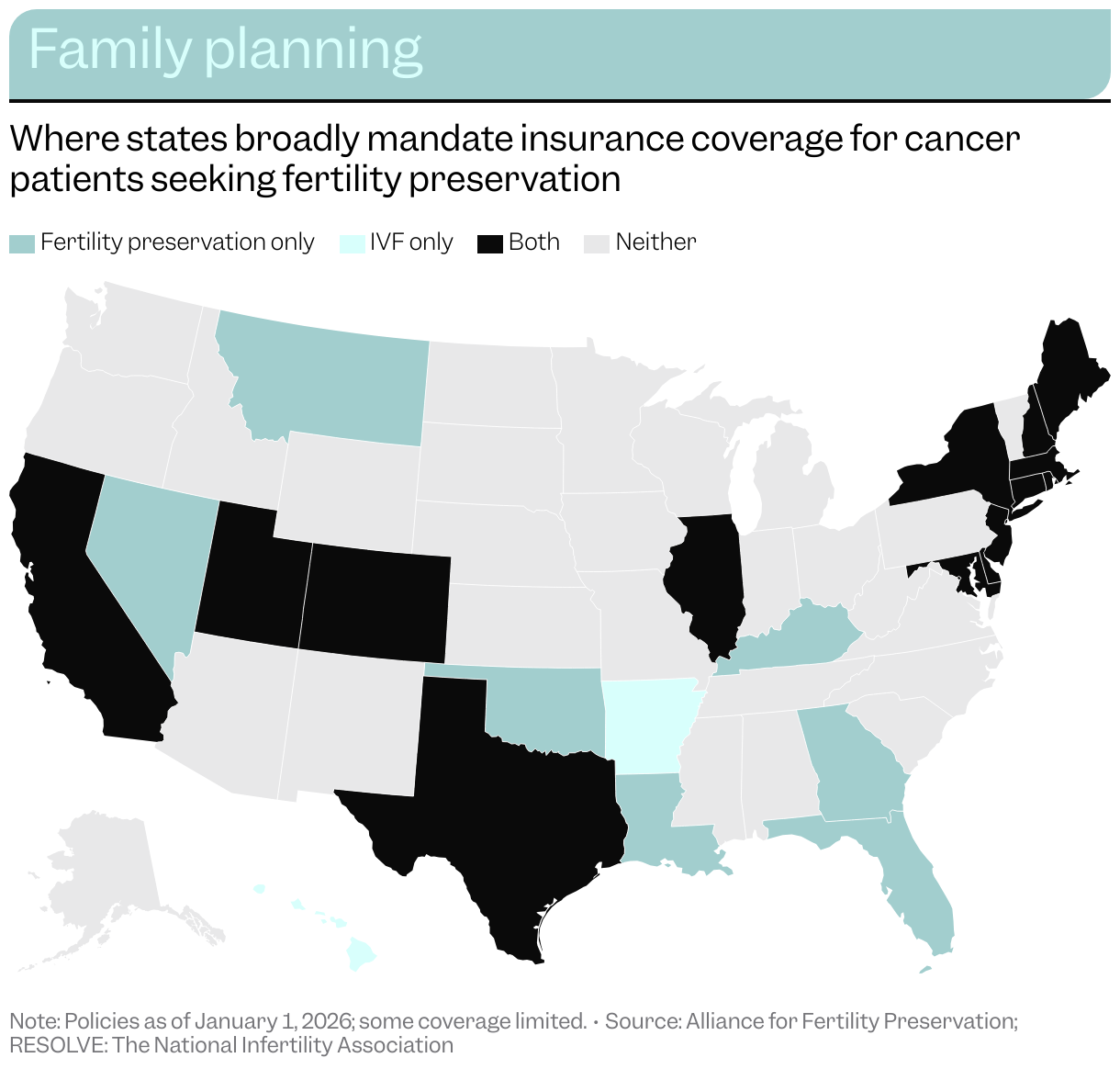
As of today, 19 US states and DC mandate insurance coverage for medically induced infertility, though some, like Kentucky and Montana, only cover the first step (freezing) and not IVF.
That means that where a cancer patient lives can radically affect the costs of having kids, or dissuade them from fertility preservation completely.
In the year that Business Insider has spent investigating young cancers, we kept hearing the same thing: more and more people are being funneled into the unruly fertility industry, with no road map or support — financially or logistically. Many young patients are given just a couple of weeks to decide how and when they want kids. Once they start cancer treatment, their choice is made.
"Hearing 'cancer' was hard enough," says Tamika Felder, who learned she had stage 2 cervical cancer at 25. "Hearing that this will impact my fertility, the bottom completely fell out for me."
Given how quickly the cancer was spreading, Felder was told she needed a hysterectomy within a few weeks. Without fertility preservation services, she would never carry a child of her own.
It wasn't an easy decision.
She was told her best option was to freeze an embryo using one of her eggs and either her then-partner's — or a donor's — sperm. (At the time, freezing embryos was regarded as more reliable than freezing eggs.) It was a lot to consider. She was working as a broadcast journalist at the time, and wasn't planning on having kids anytime soon. She also wasn't in a serious relationship or certain that she'd want a family with her partner at the time.
Money was the other major hurdle. In Maryland, where Felder was diagnosed and lives, insurance wouldn't cover any fertility preservation services. Out of pocket, embryo freezing could cost from $15,000 to $20,000, she recalled. (In 2018, Maryland revised its laws to mandate fertility coverage.)
"As a young woman who was living on her own, taking care of herself, I didn't have thousands of dollars stacked up for an emergency like this," Felder said. "I had emergency money if my car broke down, if a pipe burst in my home, but not for this."
In the end, she didn't pursue embryo freezing and lost her ability to have her own children after treatment.
That was in 2001. Felder, who's now 50, went on to launch Cervivor, a nonprofit that educates and advocates for cervical cancer patients. She says that, even if cancer patients ultimately decide not to have kids, it's important for them to feel like declining fertility preservation was truly their decision.
"Everyone I know who isn't even sure they want to be parents, when that choice is taken away from them, male or female, it is devastating for them," she said. "They go through their own emotional turmoil."
When fencesitters lose their choice
A few days after graduating from law school in San Diego, Rijon Charne learned she had stage 2 Hodgkin's lymphoma at 26. She moved back in with her parents in Dallas and got treatment at MD Anderson, one of the US's most renowned cancer hospitals, a four-hour drive away in Houston.


A doctor told Charne that her fertility would likely be unaffected if she did chemotherapy without fertility preservation services as long as she remained in remission. If the cancer returned within the next few years, the amount of chemotherapy she would need would lead to infertility. Because most Hodgkin's lymphoma relapses happen within the first three years of remission, her doctor said it would make the most sense to freeze her eggs before starting any treatment.
There was a snag: Back in 2016, insurance companies in Texas weren't required to cover egg retrieval. Charne's insurance company, through her law school, declined to pay for the $18,000 procedure.
"They told me it was 'not medically necessary' to cover my fertility treatment," Charne said. She appealed and was denied again. From that moment, she knew that if she wanted to freeze her eggs, she would need to find the funds on her own.
For those more on the fence about having kids, coverage can persuade them into taking precautions before cancer treatment. Ayisha Gomez was single and about to start a master's program in organizational leadership when she felt a lump in her breast. At 31, she was diagnosed with stage 2 breast cancer and would need to undergo a lumpectomy and chemotherapy, the latter of which could impact her fertility.
Egg retrieval wasn't top of mind. "I just wanted to get chemo over with," Gomez, 35, told Business Insider. "At the moment, I didn't really care to do fertility treatments."
Out of pocket, the procedure would have cost $11,650. In New York, where Gomez lives and was being treated, egg retrieval was fully covered by her insurance, except for $1,150 a year for egg storage. Gomez's mother convinced her to undergo an egg retrieval, just in case.
Gomez has now been cancer-free for three years — and has a partner. She plans to start the conversation about kids with her oncologists in 2026, a year before she officially reaches her five-year remission mark.
She's glad she created a backup plan years ago. If insurance had not covered the procedure, she never would have done it.
"I was making half the salary that I have now," Gomez, who is a student recruitment manager at a charter school, said. "It wouldn't have been possible."
Cobbling together coverage
Even in states with fertility preservation coverage mandates, such as Nevada and Utah, patients often face out-of-pocket costs.
When Ginny Marable was diagnosed with stage 2 cervical cancer, days before she turned 31, she and her then-boyfriend underwent IVF to freeze their embryos. She then had a hysterectomy, and her ovaries were surgically transferred to her abdomen to prevent early menopause.
At the time, Marable lived in San Diego. So, not all procedures and medications were covered. She asked her parents for help, around $10,000. For about four years, she and her now-husband also paid a $50 monthly fee to keep the embryos in storage, which she says eventually grew to $100 a month.
Mandates, she learned, have plenty of nuances. In California, for instance, Medi-Cal plans and self-insured employers are exempt. Another patient, Meagan Meadows, a student teacher diagnosed with stage 3 colon cancer at 24, told Business Insider she had to pay entirely out of pocket for her fertility preservation. Her parents' insurance from a California employer wouldn't cover egg retrieval, so she raised $10,000 through GoFundMe.
In Texas, Charne — who was denied coverage in 2016 — kept digging for options. She found a grant through the Livestrong Foundation, which covers an average of $12,000 in fertility preservation funding to cancer patients. That money, coupled with the Walgreens Heart Beat program, which pays for select fertility medications for cancer patients, covered most of her procedure.
The experience changed the trajectory of Charne's career. After going into remission, she went into fertility law and joined the Alliance for Fertility Preservation, a nonprofit that lobbied for Texas to mandate insurance coverage for cancer patients. In 2023, she testified in front of the Texas Senate, helping to pass a bill that required insurers to cover fertility preservation for anyone whose illness or injury could lead to infertility.
Now 37, Charne runs Sunray Fertility, a law firm that practices in eight states and represents cancer patients pro bono. The firm represented Felder, who reached out when she decided to try surrogacy 20 years ago to conceive a child after having a hysterectomy.
Extreme medical debt for a family
A few years after becoming cancer-free in 2017, Marable and her husband wanted to try for kids. They looked into surrogacy using their frozen embryos. It would cost $130,000 out of pocket.
"We did a number of things to fund it," Marable, 39, now living in Portland, Oregon, told Business Insider. She said they switched industries, found higher-paying roles, refinanced their home, and started a GoFundMe page.
They always dreamed of having two kids but knew they'd never be able to fund surrogacy after having their first child. Then, their embryo split — and Marable had twins.
"We're like, 'OK, our family is complete, so what are we going to do with the rest of our embryos?'" Marable said.
Through online Cervivor events, she had met Felder, whose story of losing her fertility decades earlier had stayed with her. Weeks after her sons were born in 2021, Marable reached out to Felder and offered to donate her remaining four embryos.
Felder saw Marable's offer as a gift and a second chance. Still, surrogacy would cost $150,000 to $175,000, including travel across the country to appointments.
With the help of Charne — who was by then a practicing fertility lawyer — and a surrogacy agency that waived its fees, Felder cut her estimated out-of-pocket costs nearly in half to around $80,000. She took on extra speaking gigs, while her husband sold some of his cryptocurrency and worked longer hours to afford the process.
"There came a point where we thought we're going to have to sell one of our cars," Felder said. "We worked really hard to make it happen."
In 2022, their surrogate gave birth to their son, Chayton.
Like Charne, Felder began sharing her story publicly to push for policy change. She joined the Alliance for Fertility Preservation and testified before Maryland lawmakers, one of the hardest experiences of her life. By 2018, Maryland passed a law mandating insurance coverage for medically induced infertility.
Since then, other states have followed. Florida and Georgia passed fertility preservation mandates that will be active as of 2026, and federal lawmakers recently reintroduced the Access to Fertility Treatment and Care Act, which would require nationwide coverage for fertility preservation and IVF for cancer patients.
"My son will be 3 in November, and we still have not recovered financially," Felder said. "But it was worth every single penny."
