A blank rectangle of a building sits next to a highway, facing an endless Wyoming prairie. It's painted the greenish-grayish-brown that Disneyland imagineers use on stuff they don't want people to notice. But the nine semitrailer-size green boxes nestling like nursing puppies into the building's long sides are a giveaway. They're giant heat exchangers meant to chill the stacks of black, pizza-box-shaped computers inside, squeezing electrons through silicon to make everything from streaming video to cryptocurrency.
This data center is one of several in Cheyenne. These buzzing hives of circuitry run the modern digital economy — and manage the unprecedented quantities of data and computation necessary for artificial intelligence.
Tech companies are racing to dominate a speculative future built on AI. Together, Amazon, Microsoft, Meta, and Google's parent, Alphabet, have said they'll spend at least $320 billion this year alone on facilities and equipment, overwhelmingly for AI.
Over several months, a team of Business Insider reporters and editors has delved deep into this nationwide infrastructure project. To create a comprehensive national list of data centers, we looked at the mass of permits to build these facilities. We learned how much water and electricity these places use, or are expected to, and the consequences for people's everyday lives.
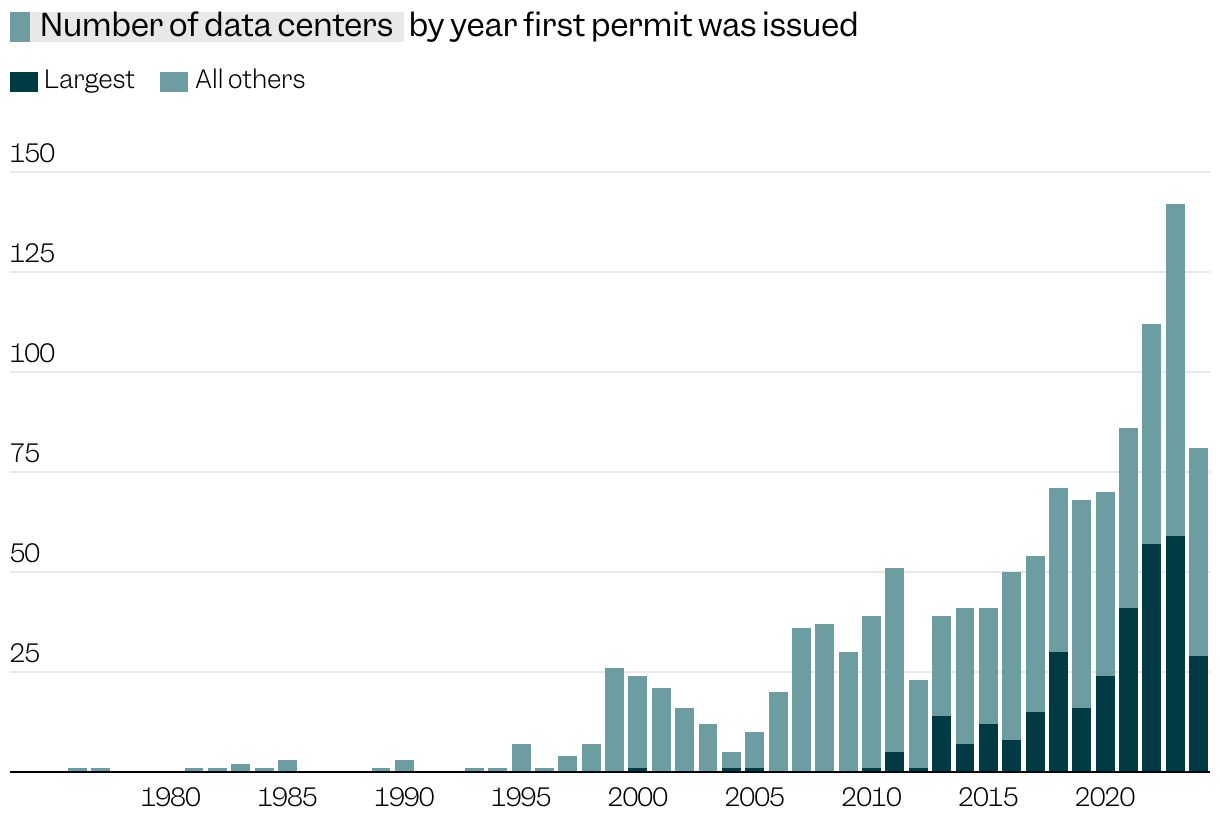
Business Insider identified 1,240 data centers in America already built or approved for construction at the end of last year — the most comprehensive tally to date. That's nearly four times the number in 2010. Hundreds of those are the "hyperscalers" spinning up largely to power AI, the physical instantiation of a vast bet on a multitrillion-dollar reimagining of the global economy.
Tech companies envision a world where AI algorithms can replace doctors, make uncannily accurate disaster predictions, come up with universe-altering theories, act as personal assistants, teach our kids, or provide, ahem, companionship.
"You have to have the ability to create, right?" says Cortney Thompson, chief information officer and cofounder of Lunavi, which owns the Cheyenne data center. "Whether that's on somebody else's platform, whether it's your own infrastructure, you have to have those resources available to create and innovate."
That's the possible upside. Business Insider's analysis exposes the downsides — the costs we're paying now.
We found that four out of 10 US data centers are (or are set to be) in places seriously short of water, and some of those facilities are permitted to guzzle millions of gallons a day.
Collectively, Business Insider estimates, US data centers could soon consume more electricity than what Poland, with a population of 36.6 million, used in 2023. Federal estimates expect that to as much as triple over the next three years.
The power plants that fuel that need will emit enough pollution to cause between $5.7 billion and $9.2 billion a year in public health costs, according to Business Insider estimates.
Taxpayers are subsidizing much of this boom, as local governments vie for projects they hope will refashion their towns into high-tech hubs with high-paying jobs. Business Insider found that many cities in places like central Ohio are giving sweeping tax breaks to tech giants that over years amount to $1 million or more for each long-term job.
Industry representatives say they're working to reduce or offset the drawbacks — investing billions of dollars a year in green energy infrastructure, paying to restore water sources, and building more efficient tech. They point out that they're responding to demand from consumers and corporations for a technology that could transform not just apps or devices but society itself. They believe the resource investment will be worthwhile.
Either way, the bills are coming due.
Secret costs
Virginia today is full of data centers — 329 of them, handling as much as a third of the planet's internet traffic and consuming almost a fourth of the state's electricity in 2023. There, and throughout the US, their construction is regulated by counties and regional utilities. Since regulating American land use is typically a local matter, data center construction usually gets brokered between the private-jet-flying, expensive-suit-wearing representatives of transnational technology oligopolies and, like, Dave from the local planning commission.

As an indirect consequence of that lopsided relationship, the amount of electricity and water those data centers use has been, effectively, secret — until now.
Data centers draw power from the local utility grid. But they have to run 24/7, so if that power goes out, they rely on backup generators that burn diesel fuel or natural gas. To run them, data center owners must get permits, which require an accurate accounting of their emissions. That output maps to the data center's power needs. By obtaining 1,240 permits from across the US, Business Insider calculated the potential near-term ecological footprint of every US data center owner, based on our estimate of how much electricity data centers typically use relative to the capacity of their backup systems. (See here for more on Business Insider's methodology.)
Amazon tops the list. Business Insider's estimate indicates that if it builds all the data centers it has planned, it would use 30 to 48 terawatt-hours a year. At the midpoint, that would be around the same amount of electricity the state of Nevada used in 2023.
An Amazon spokesperson said Business Insider's methodology for estimating consumption "oversimplifies complex data center operations and is based on assumptions that do not account for important differences in how companies build and operate data centers."
Google and Meta did not respond to Business Insider's queries about data center power use estimates, and QTS declined to comment. A Microsoft spokesperson acknowledged that its data centers "do not always run at 100% of their installed capacity."
The federal government estimates that demand for electricity will rise more this decade than it has since the 1980s; some calculations say data centers account for as much as 44% of that growth. Meeting that new demand will mean keeping older, dirtier generation capacity online — climate crisis and carbon commitments be damned.
Water is the most effective way to cool down the hotter, more closely packed graphics processing units that AI relies on. And that water often has to be fresh. Data centers are finicky drinkers.
In 2018, before the AI boom, US data centers consumed 34 billion gallons a year — just about what the state of California uses every day. Just seven years later, the US has doubled its data center capacity.
Now, here is where you'd expect a story like this to tell you how much water any data center of a given size uses. That's almost impossible. Just half of all data center operators track their water use, and it's wildly variable depending on size and technology.
Thanks to the air permits Business Insider examined, we can at least tell you where those data centers are. That's important because, given their needs, you might think that companies would site them near ready supplies of fresh water. They often don't.
In fact, 40% of the data centers in the US are (or are set to be) in places marked by the World Resources Institute — a sustainability advocacy group — as having high or extremely high water scarcity. That includes multiple parts of the arid American Southwest — like Arizona's Maricopa County, an "extremely water-stressed area" with 48 data centers.
Data center builders know all this, and they take water seriously. The biggest water users have pledged to do better — to be water-neutral in coming years, to pay other users to use less, or to fund water conservation projects as offsets. And they point out that just because they have permission to use millions of gallons of water a day doesn't mean they will — and where water is scarce, they tend to favor air-cooling tech instead.
Of course, air cooling needs power. And however much they draw, data centers' power needs are big enough that they tend to raise local electricity bills for everyone, Business Insider found — whether homes or Walmarts.
Their punishingly noisy cooling fans run all day and all night, making it tough for some who live near data centers. Every drop of water that goes to a data center could've gone to a home, or a different industrial or agriculture use — and outflows from the cooling systems risk polluting local waterways.
A future reckoning
Technological improvements could obviate this someday. More efficient heat exchangers could solve the cooling problem. A more flexible power grid or AI that uses far less energy might solve the power problem.
Though some utilities are bringing new fossil-fuel plants online, renewable solutions are emerging — a few miles from the data center in Cheyenne, a massive solar farm is rising alongside hundreds of already-spinning wind turbines.
We can marvel at new applications like real-time language translation or more accurate cancer diagnoses. We can scoff at the latest chatbot hallucination — or worry about policy or military decisions made not in the White House or the Pentagon but in data centers guided by algorithms few understand. All this happens while water aquifers drain and electricity bills climb.
A handful of transnational corporations are offering this proposition: They will usher in an age of technological wonder in return for the opportunity to make a tremendous amount of money. State after state is giving them more money, and reorienting entire regulatory structures, to let them do it. If the AI revolution delivers, perhaps the ledger eventually balances. If not, we'll be left with the receipts for a future that never arrived.
Watch Business Insider's documentary, which identifies how data centers have transformed landscapes and how people living nearby are also counting the cost.